Indoor air quality can shape how you feel long before you notice a visible problem. A room may look clean yet still contain particles, gases, moisture, allergens, combustion byproducts, or pollutants brought in from outdoors. In practical terms, indoor air quality is shaped by what enters, what is generated inside, and how effectively pollutants are removed. Because people spend so much of daily life inside homes, offices, schools, and vehicles, repeated exposure matters even when no single moment feels dramatic.
The practical lesson is simple: healthier indoor air is not mainly about making a room smell “fresh.” It is about identifying sources, limiting emissions, bringing in cleaner outdoor air when conditions allow, controlling moisture, and using filtration as a supporting tool. The U.S. Environmental Protection Agency describes indoor pollution sources that release gases or particles as a primary cause of indoor air problems, while inadequate ventilation can allow pollutants to build up.
Quick takeaway: the most reliable strategy is layered. First control the source, then ventilate appropriately, then use targeted filtration or air cleaning when it can address the pollutant you actually have.
Why indoor air can affect health and comfort without obvious warning
Indoor air is a changing mixture rather than a fixed substance. Cooking, showering, cleaning, burning candles, using a fireplace, applying paint, opening a window near traffic, or simply having several people in a small room can change that mixture within minutes. Some pollutants are particles that can be inhaled deep into the respiratory tract. Others are gases or vapors that may irritate the eyes, nose, throat, or lungs, and some exposures matter because they are repeated over long periods.
Short-term effects can include irritation, headache, fatigue, dizziness, coughing, wheezing, or worsening of existing respiratory symptoms. These symptoms are not specific to indoor pollution, so they should not be used as a self-diagnosis. Long-term risk depends on the pollutant, concentration, duration of exposure, individual susceptibility, and other health factors. EPA notes that certain indoor-air exposures have been associated with respiratory disease, heart disease, and cancer, while also emphasizing that people can respond differently to the same environment.
Susceptibility also varies across a household. Children breathe more air relative to body size than adults and spend time closer to floors where dust accumulates. Older adults and people with asthma, chronic lung disease, cardiovascular disease, or chemical sensitivities may notice problems sooner. A home that feels acceptable to one person may still aggravate symptoms in another.
This is why indoor air quality should be treated as an exposure-management issue, not a cleanliness contest. A spotless kitchen can still have cooking particles, and a pleasant fragrance can coexist with volatile chemicals. Conversely, a room with some ordinary dust is not automatically hazardous. The goal is to recognize meaningful sources and reduce avoidable exposure.
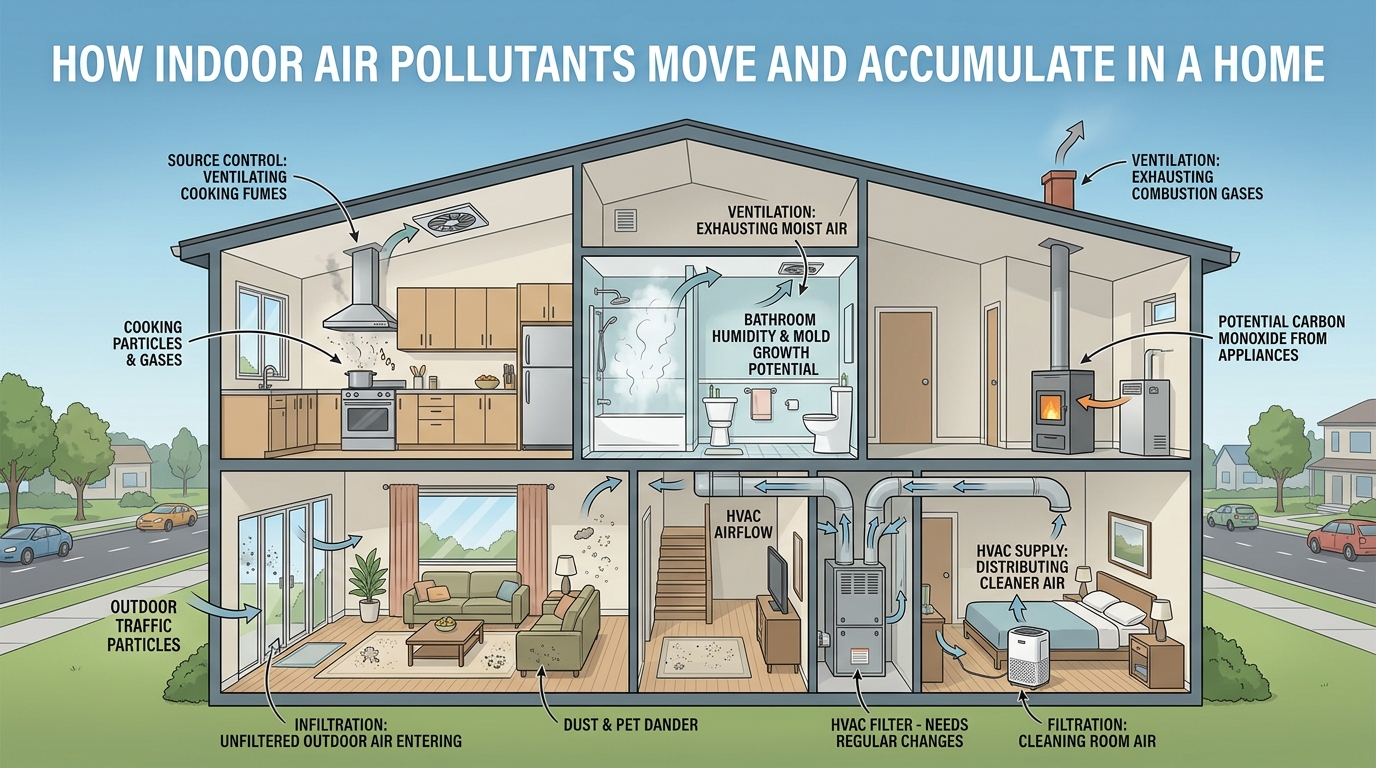
The main indoor pollutants and where they come from
Different pollutants behave differently, so the first useful question is not “Is my air bad?” but “What might be in the air, and where could it be coming from?” Common categories include particulate matter, combustion gases, volatile organic compounds, biological contaminants, radon, and outdoor pollution that leaks or is ventilated indoors.
| Pollutant or factor | Common indoor sources | Why it matters | Useful first response |
|---|---|---|---|
| Fine and coarse particles | Cooking, smoke, candles, fireplaces, dust, outdoor air | Can irritate airways and, when small enough, penetrate deeply into the lungs | Reduce the source, exhaust cooking emissions, improve particle filtration |
| Carbon monoxide | Faulty or unvented fuel-burning appliances, generators, combustion | Colorless, odorless gas that can cause severe poisoning | Use a proper carbon monoxide alarm and maintain combustion appliances |
| Nitrogen dioxide and combustion byproducts | Gas cooking, heaters, fireplaces, tobacco smoke | Can irritate the respiratory system and worsen respiratory symptoms | Vent fuel-burning sources outdoors and use exhaust ventilation |
| Volatile organic compounds | Paints, cleaners, adhesives, furnishings, fragrances, hobby products | Some can cause irritation or other health effects depending on chemical and dose | Limit use, follow labels, store properly, ventilate during use |
| Biological contaminants | Mold, dust mites, pet dander, pollen, pests | May trigger allergies or asthma in susceptible people | Control moisture, clean effectively, reduce reservoirs |
| Radon | Soil gas entering through foundations and openings | Long-term exposure increases lung-cancer risk | Test the home; mitigate when levels are elevated |
| Excess humidity | Leaks, showers, drying clothes indoors, poor exhaust | Encourages mold growth and dust mites | Fix moisture sources and improve exhaust or dehumidification |
The World Health Organization’s indoor-air guidance specifically addresses pollutants such as benzene, carbon monoxide, formaldehyde, nitrogen dioxide, and radon because they can have indoor sources and documented health relevance. The key point is that one device or one number cannot represent every pollutant at once.
Particles deserve special attention because particulate matter can be generated by cooking, burning candles, smoking, using fireplaces, cleaning, and other ordinary activities. Outdoor particles from traffic, wildfire smoke, road dust, and pollen can also enter through doors, windows, cracks, and ventilation systems. This means “close every window” and “open every window” are both oversimplified rules; the better choice depends on what is happening indoors and outdoors at that moment.
How poor indoor air can affect breathing, energy, sleep, and daily well-being
The respiratory system is the most obvious pathway because every breath brings indoor air into direct contact with the nose, throat, and lungs. Irritants and particles may contribute to coughing, throat discomfort, nasal symptoms, chest tightness, or asthma flare-ups in susceptible people. Fine particles are especially important because smaller particles can travel deeper into the lungs than larger dust that settles quickly.
Well-being effects can be more subtle. A poorly ventilated, crowded room can feel stuffy and uncomfortable. Strong odors or chemical vapors can provoke headache or nausea in some people. High humidity can make a room feel oppressive and can support biological growth, while very dry air may increase irritation for some occupants. These experiences do not prove that a dangerous pollutant level is present, but they are useful clues that the indoor environment deserves attention.
Sleep can also be affected indirectly. A bedroom with excessive heat, humidity, allergens, smoke infiltration, or irritating odors may make it harder to rest comfortably. Someone with allergic rhinitis or asthma may wake because of nasal obstruction or coughing. The useful response is to look for the driver: moisture, bedding allergens, pet dander, smoke, fragrance, or insufficient ventilation may require different remedies.
Long-term health questions are more complex. WHO’s global air-quality guideline summarizes extensive evidence linking air pollution exposure with cardiovascular and respiratory disease and other serious outcomes. Indoor exposure may include both pollutants created inside and outdoor pollutants that move indoors. That is why reducing avoidable exposure is worthwhile even when a home does not produce immediate symptoms.
The three-part control strategy: source, ventilation, filtration
A practical indoor-air plan works best in a clear order. Source control comes first. If smoke is being produced indoors, stopping the smoke source is more effective than trying to filter it after it spreads through the room. If a bathroom leak is feeding mold growth, fixing the leak matters more than masking the odor. If a solvent is being used, choosing lower-emission practices and following label ventilation instructions can reduce the amount released into the air.
Ventilation comes next. Ventilation dilutes or removes indoor pollutants by exchanging indoor air with outdoor air or exhausting contaminants directly at the source. Kitchen range hoods that vent outdoors, bathroom exhaust fans, and local exhaust in workshops are examples of source-focused ventilation. Opening windows can also help when outdoor air is reasonably clean, but it can be counterproductive during wildfire smoke, heavy traffic pollution, or high-pollen conditions.
Filtration is the third layer. EPA states that filtration can be an effective supplement to source control and ventilation. A portable air cleaner can reduce airborne particles in a room when it is appropriately sized and operated, and a compatible MERV-rated HVAC filter can improve particle removal in a central system. However, filtration cannot repair a gas leak, remove radon from the soil beneath a home, fix damp building materials, or replace safe combustion practices.
This order prevents a common mistake: using air cleaning as permission to continue a high-emission activity. A portable air cleaner may lower particle levels during cooking, for example, but an effective range hood and lower-emission cooking practices can prevent a large fraction of those particles from spreading in the first place. Likewise, filtration can reduce some airborne mold particles, but the moisture source still has to be corrected.
Room-by-room actions that make the biggest practical difference
Kitchen
Cooking is one of the most variable indoor particle sources. Use the range hood whenever cooking, preferably one that exhausts outdoors, and keep it running briefly after cooking is finished. Back burners may capture emissions more effectively under some hoods because they sit closer to the capture area. Avoid deliberately charring food indoors, and clean accumulated grease and crumbs that can smoke when heated.
Bathroom and laundry areas
Moisture control is the priority. Run the bathroom exhaust fan during showers and long enough afterward to remove excess humidity. Repair leaks rather than repeatedly drying the same wet surface. Vent clothes dryers outdoors where applicable. A hygrometer can help you notice persistent high humidity, but it is the moisture source and ventilation pattern that need correction.
Bedroom
Focus on allergen reservoirs and overnight exposure. Wash bedding regularly, keep mattresses and pillows dry, and consider mattress dust-mite covers when dust-mite allergy is a known problem. Keep pets out of the bedroom if pet dander clearly aggravates symptoms. During high outdoor pollution or pollen periods, keep windows closed and rely on appropriate filtration rather than bringing the outdoor problem inside.
Living areas
Reduce avoidable combustion and fragrance sources. Burning candles and incense adds particles and combustion byproducts. Tobacco smoke should not be allowed indoors. Vacuuming can temporarily resuspend dust, so a HEPA vacuum and damp dusting can help reduce recirculation, especially when someone in the household has asthma or allergies.
Garage, workshop, and hobby spaces
Keep paints, solvents, fuels, pesticides, and adhesives sealed and stored according to their labels. Use local exhaust or outdoor work areas for activities that produce dust or vapors. Never run gasoline-powered engines, grills, or generators in a garage or other enclosed space where carbon monoxide can accumulate. A carbon monoxide alarm is an emergency safety device, not a substitute for safe combustion practices.
Moisture, mold, and allergens: why controlling water often matters more than cleaning the air
Mold is not primarily an air-cleaner problem. It is a moisture problem. Spores are common in the environment, but persistent dampness allows growth on building materials, furnishings, and dust. If a wall, ceiling, carpet, or cabinet repeatedly becomes damp, the durable solution is to stop the water intrusion or condensation and dry the material.
EPA guidance recommends drying damp or wet materials promptly and keeping indoor relative humidity below 60% when possible, ideally around 30% to 50%. These numbers are best treated as practical targets rather than a reason to obsess over minute-to-minute changes. Climate, season, building design, and occupant comfort all matter. Persistent condensation on windows or pipes is a useful sign that moisture management deserves attention.
Dust mites, mold, cockroaches, pollen, and pet dander can contribute to allergen exposure. Cleaning reduces reservoirs, but technique matters. Damp dusting keeps settled particles from becoming airborne again. Vacuuming carpets and upholstered furniture with effective filtration can reduce dust buildup. Bedding can be washed and dried thoroughly, and a dehumidifier may be useful where humidity remains high despite fixing leaks and using exhaust ventilation.
If visible mold covers a large area, keeps returning, follows major water damage, or involves contaminated building materials, professional assessment may be appropriate. People with significant respiratory disease, immune compromise, or severe symptoms should avoid unnecessary exposure during cleanup and discuss health concerns with a qualified clinician.
What air purifiers and filters can do—and what they cannot
Air purifiers are most useful when the target pollutant is airborne and the device is designed to remove it. Particle filters can reduce airborne dust, pollen, smoke particles, and other particulate matter. HEPA is a high-efficiency particle-filter category, while central HVAC systems commonly use filters described by MERV ratings. An activated-carbon filter may help with some gases or odors when it contains enough adsorbent material, but gas removal is more complicated than particle capture.
Performance depends on more than the filter label. A portable air cleaner has to move enough air through its filter for the room where it operates. Run time and fan speed matter. Placement matters because blocked intakes or outlets reduce airflow. Filters also need replacement or cleaning according to the manufacturer’s instructions; an overloaded filter cannot perform as intended.
Air cleaning has clear limits. It cannot remove every pollutant, and one technology may work for particles but not gases. It cannot make unsafe combustion safe, and it cannot solve structural moisture problems. It also cannot tell you whether an unexplained symptom is caused by indoor air. Think of a portable air cleaner as one tool in a broader exposure-control plan rather than a universal solution.
For particle pollution, an activated-carbon filter can be paired with particle filtration when gaseous pollutants or odors are also a concern, but it should not create a false sense of security. Source control and ventilation remain essential. A portable air cleaner may be especially useful during periods when windows should remain closed because outdoor smoke or pollution is high.
Monitoring indoor air without becoming trapped by the numbers
Consumer sensors can be useful for pattern recognition. An air quality monitor may show that particle levels rise sharply during frying, that carbon dioxide rises when several people occupy a closed room, or that humidity remains high after showers. This can help connect an activity with an environmental change and test whether an intervention—such as using a range hood or opening a window when outdoor air is clean—improves the pattern.
But low-cost air pollution monitors do not give a complete representation of indoor air quality. A sensor only measures the pollutant or environmental factor it was designed to detect, and consumer devices vary in accuracy, precision, calibration, placement sensitivity, and response to humidity or interfering chemicals. A PM sensor cannot rule out radon. A carbon-dioxide sensor cannot rule out carbon monoxide. A “VOC” reading usually cannot identify every individual chemical in the room.
Use monitor data as a clue, not a diagnosis. Look for repeated trends rather than reacting to every momentary spike. Place sensors away from direct drafts, windows, stoves, or other locations that can distort readings unless the device instructions specify otherwise. If a reading suggests a known hazard—such as elevated radon—follow the established testing or professional mitigation pathway for that hazard.
A radon test kit addresses a specific pollutant that general-purpose monitors may not measure reliably. A smoke detector and a certified carbon monoxide alarm serve emergency functions that ordinary indoor-air sensors do not. These distinctions matter because the wrong tool can provide reassurance without actually detecting the most dangerous condition.
A practical indoor air quality checklist for the next seven days
- Day 1: Walk through the home and list obvious sources: smoking, candles, gas appliances, fireplaces, fragrances, cleaning chemicals, hobbies, damp areas, attached garage, and outdoor pollution entry points.
- Day 2: Check that the kitchen range hood and bathroom exhaust fan actually move air. Clean accessible grilles and note whether the range hood vents outdoors or merely recirculates.
- Day 3: Look for water stains, condensation, damp carpet, plumbing leaks, musty odors, or persistent bathroom humidity. Fix the moisture source rather than covering the smell.
- Day 4: Review HVAC maintenance. Replace the MERV-rated HVAC filter if it is due, using a rating the system can handle. Check replacement air filters for portable units and follow the manufacturer’s schedule.
- Day 5: Reduce dust reservoirs with damp microfiber cleaning cloths and a well-maintained vacuum. If allergies are a problem, consider a HEPA vacuum and keep the sensitive person away while dust is being stirred up.
- Day 6: Confirm that working smoke detector and carbon monoxide alarm devices are installed and maintained according to local requirements and manufacturer instructions.
- Day 7: Choose one measurable behavior change, such as always using the range hood, reducing candle use, controlling bedroom humidity, or running a portable air cleaner during smoke events. Recheck the result after a week.
Other useful tools may include a hygrometer for humidity, a dehumidifier for persistently damp spaces after moisture sources are addressed, a bathroom exhaust fan where ventilation is inadequate, and weather stripping for controlling uncontrolled air leakage in appropriate situations. A window fan can assist ventilation when outdoor air is clean, while a humidifier cleaning brush may make routine maintenance easier if a humidifier is used. None of these tools replaces the need to understand the pollutant source.
Frequently asked questions about indoor air quality
1. Can I tell indoor air quality by smell?
No. Odor can be a useful clue, but many important pollutants are odorless, including carbon monoxide and radon. Some strong odors may be unpleasant without indicating the greatest health risk, while dangerous conditions can occur without any smell at all. Use source awareness, proper alarms, specific testing, and ventilation practices rather than smell alone.
2. Should I keep windows open all day?
Not automatically. Opening windows can dilute indoor pollutants when outdoor air is clean, but it can increase exposure during wildfire smoke, high-pollen periods, heavy traffic pollution, or extreme weather. Ventilation should be matched to current indoor and outdoor conditions.
3. Is an air purifier enough to fix bad indoor air?
No. Air cleaning is usually a supplement. It can reduce certain airborne particles and, with appropriate media, some gases, but it cannot stop a leak, vent a combustion appliance, remove radon at its source, or correct mold-causing moisture. Start with source control and ventilation.
4. Does a HEPA filter remove every indoor pollutant?
No. HEPA filters are designed for particles, not every gas or vapor. They can be highly effective for airborne particles when enough air passes through them, but gaseous pollutants may require source control, ventilation, or specialized sorbent media. Even then, no filter should be treated as universal protection.
5. What humidity level is best for a home?
EPA guidance commonly points to keeping indoor relative humidity below 60% and, when practical, around 30% to 50% to discourage mold and dust mites. Comfort and building conditions vary, so the main concern is persistent dampness, condensation, or moisture damage rather than chasing a single exact number.
6. Are consumer air-quality monitors medically reliable?
They can be useful for trends, but they are not medical diagnostic devices and do not measure every pollutant. Their readings can be affected by placement, humidity, sensor type, calibration, and other conditions. Use them to identify patterns and guide practical actions, not to diagnose illness or declare a room universally safe.
7. When should I involve a professional?
Professional help is sensible when there is suspected combustion backdrafting, repeated carbon-monoxide concerns, significant water damage or recurring mold, elevated radon requiring mitigation, persistent unexplained odors, or a ventilation problem that cannot be corrected safely. If people are experiencing ongoing or severe symptoms, medical evaluation is also appropriate because many health problems can mimic “bad air” symptoms.
Conclusion: healthier air comes from controlling exposure, not chasing perfect readings
Indoor air quality is best understood as the result of sources, airflow, moisture, filtration, outdoor conditions, and human activity interacting over time. The most effective improvements are usually ordinary and specific: stop avoidable pollution at the source, exhaust cooking and moisture where they are generated, ventilate with cleaner outdoor air when conditions allow, maintain combustion equipment, control dampness, clean dust reservoirs, and use filtration for pollutants it can actually capture.
Monitoring can make hidden patterns visible, but numbers are only useful when they lead to sensible action. The goal is not to create a perfectly sterile indoor environment or to react anxiously to every sensor fluctuation. The goal is to lower meaningful exposure and create a home that is easier to breathe in, more comfortable to live in, and safer over the long term.
If you remember one principle, use the layered approach: remove or reduce the source, ventilate appropriately, and filter what remains. That framework is more durable than any single gadget because it addresses why pollutants are present in the first place.