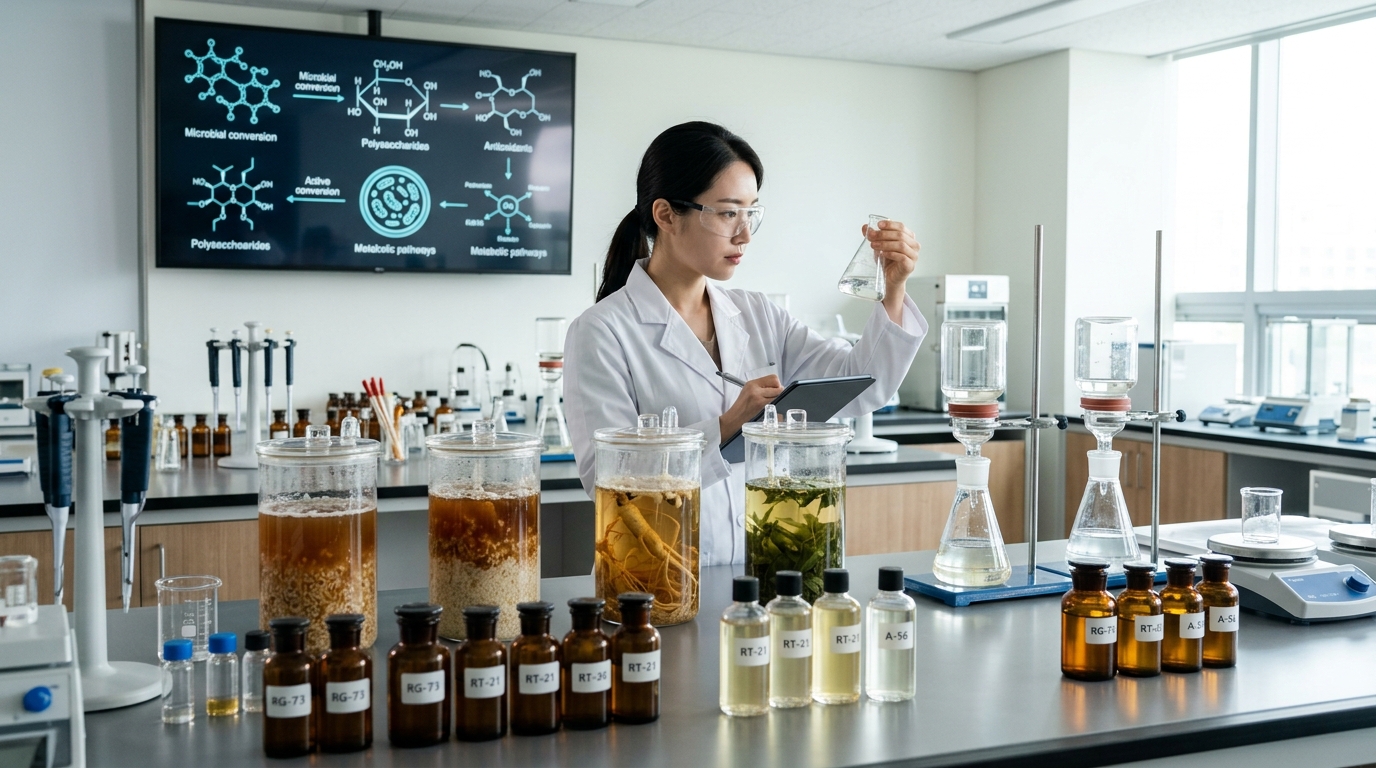
Fermented Korean skincare ingredients appear in essences, toners, serums, masks, and creams under names such as Galactomyces ferment filtrate, Bifida ferment lysate, Lactobacillus ferment, Saccharomyces ferment filtrate, and fermented rice extract. These names may sound as though a cosmetic contains the same living cultures found in yogurt or kimchi, but the chemistry is usually very different. Most conventional leave-on cosmetics contain filtered fermentation liquids, microbial fragments, lysates, purified metabolites, or fermented botanical extracts rather than a thriving population of live microorganisms.
Fermentation is best understood as a manufacturing process. A selected microorganism is supplied with a substrate, such as sugar, rice, soy, ginseng, yeast nutrients, or another botanical material. As the organism grows, its enzymes break down some molecules and build others. The resulting material may then be filtered, heated, concentrated, separated, inactivated, or blended into a preserved cosmetic formula.
The scientific question is therefore not simply whether an ingredient was fermented. The useful questions are which organism was used, what it was fed, how the process was controlled, what remained after processing, how much was added to the final product, and whether that finished formula was tested on human skin. A ferment can be chemically interesting without automatically producing a visible benefit in every formula or for every user.
What Fermentation Means in Cosmetic Science
Fermentation uses the metabolism of microorganisms as a biochemical production system. Yeasts, lactic acid bacteria, Bacillus species, fungi, and other organisms can release enzymes into a growth medium or use enzymes inside their cells to transform the starting substrate. Temperature, oxygen, acidity, nutrient supply, fermentation time, and the identity of the strain all influence the final mixture.
The peer-reviewed review “Unlocking the Potential of Fermentation in Cosmetics” describes fermentation as a platform that can generate or transform many classes of cosmetic ingredients rather than one single type of active. The process has been investigated for producing biosurfactants, polysaccharides, organic acids, enzymes, aroma compounds, antioxidant molecules, and complex extracts used in skin and hair formulations.
That breadth explains why the word ferment on a label does not predict one standard function. One ferment may mainly act as a humectant-rich conditioning material. Another may supply polysaccharides that influence texture. A third may contain cell-wall fragments studied for interactions with skin cells. A fermented oil or biosurfactant has a different purpose again.
Fermentation is a controlled transformation, not a synonym for stronger skincare.
How Microbes Change a Raw Ingredient
The first biochemical route is enzymatic breakdown. Plant materials often contain sugars, proteins, phenolic compounds, and glycosides in relatively complex forms. Microbial enzymes can cleave chemical bonds and release smaller molecules. For example, glycosidases may remove sugar groups from botanical compounds, proteases may split proteins into smaller peptides and amino acids, and carbohydrate-processing enzymes may change polysaccharides.
The review “Biological and Cosmetical Importance of Fermented Raw Materials” explains that microbes may convert larger substrate compounds into smaller structures while adding or enriching metabolites such as organic acids, amino acids, and antioxidants. This can change solubility, sensory feel, chemical reactivity, and the way an extract behaves inside a formula.
The second route is biosynthesis. Microorganisms do not merely digest the starting material; they also make new substances as they grow. Depending on the strain and conditions, these may include lactic acid, peptides, extracellular polysaccharides, enzymes, amino acids, lipids, vitamins, and antioxidant-associated metabolites.
The third route is selective reduction. Fermentation may lower the level of a starting compound by consuming or transforming it. This can sometimes reduce an undesirable odor, alter color, change viscosity, or lower the concentration of a poorly tolerated constituent. However, reduced irritation cannot be assumed merely because fermentation occurred. The new mixture may also contain acids, fragrance-related molecules, residual proteins, or other compounds that do not suit every skin type.
Filtrate, Lysate, Extract, and Postbiotic Are Not Interchangeable
Cosmetic labels use several terms that describe different processing outcomes. A ferment filtrate is generally the liquid fraction obtained after a fermentation mixture has been filtered. Depending on the filtration method, it may contain soluble metabolites and substrate-derived compounds while excluding most intact cells. A lysate is produced when microbial cells are broken apart, so the resulting material may contain cell-wall fragments, intracellular components, and metabolites.
A fermented botanical extract begins with plant material that has been exposed to microbial transformation. Its chemistry comes from both the original plant and the fermentation process. A filtrate made by growing yeast in a defined nutrient medium is not chemically equivalent to rice, soybean, ginseng, or tea fermented with another organism.
The ISAPP consensus defines a postbiotic as a preparation of inanimate microorganisms and/or their components that confers a demonstrated health benefit on the host. Under that definition, substantially purified metabolites and cell-free filtrates without microbial components are not automatically postbiotics. Evidence of benefit is also part of the definition rather than an optional marketing addition.
| Label or material type | What it may contain | How it is produced | Scientific limitation |
|---|---|---|---|
| Ferment filtrate | Soluble metabolites, organic acids, peptides, sugars, and transformed substrate compounds | The fermentation broth is filtered to remove much or most of the cellular material | Composition varies with strain, medium, filtration, and concentration |
| Ferment lysate | Broken microbial cells, cell-wall components, intracellular material, metabolites, and processing residues | Microbial biomass is cultured, inactivated, disrupted, and processed | Laboratory activity does not establish a benefit at the concentration used in a finished product |
| Fermented botanical extract | Plant compounds plus microbial transformation products | Rice, soy, ginseng, tea, or another substrate is fermented and extracted | Benefits cannot be generalized from one plant, organism, or extraction method to another |
| Purified fermentation metabolite | A defined acid, peptide, polymer, enzyme, or other isolated compound | Fermentation is followed by separation and purification | The purified molecule should be evaluated according to its own chemistry rather than the reputation of fermentation |
| Postbiotic preparation | Inanimate microorganisms or their components, sometimes with metabolites | A characterized microbial preparation is deliberately inactivated and formulated | It should not be called postbiotic under the scientific definition without demonstrated benefit |
| Finished cosmetic | Ferment material plus water, humectants, emollients, emulsifiers, preservatives, fragrance, and other ingredients | The ferment is incorporated into a stable, preserved formulation | Observed results belong to the complete formula, not automatically to one highlighted ingredient |
Why Smaller Molecules Do Not Automatically Mean Deeper Penetration
A popular explanation claims that fermentation makes molecules smaller so they penetrate more deeply. This is only partly useful. Microbial enzymes can indeed transform some large compounds into smaller ones, but molecular size is only one factor controlling skin delivery. Charge, polarity, oil-water balance, concentration, vehicle, skin condition, and interactions with other formulation ingredients also matter.
The outermost stratum corneum is designed to limit entry. Many water-soluble metabolites remain largely near the surface, where they may still be useful as humectants or conditioning agents. A molecule does not need to reach the living dermis to improve softness, reduce surface water loss, or support the feel of a moisturizer.
Claims about “better absorption” therefore require direct comparison. Researchers would need to characterize the fermented and unfermented materials, apply equivalent doses in comparable vehicles, and measure delivery or biological response. The word fermented alone does not prove that every useful compound became smaller, more stable, or more bioavailable.
Ferments and the Skin Barrier
The skin barrier depends on organized corneocytes, surrounding lipids, natural moisturizing factors, tight junctions, controlled shedding, and coordinated immune defenses. A cosmetic can support this system in several ways: supplying humectants, reducing evaporation with emollients or occlusives, maintaining a tolerable pH, limiting irritation, or influencing cellular pathways associated with differentiation and defense.
Fermentation-derived mixtures may contain amino acids, sugars, organic acids, and polysaccharides that help bind water at the surface. Other components are being studied for effects on keratinocyte differentiation, junction proteins, oxidative responses, and inflammatory signaling. These possibilities are chemically plausible, but the evidence differs greatly from one named ferment to another.
A 2024 Journal of Dermatological Science study reported that Galactomyces ferment filtrate influenced epidermal differentiation and cell-to-cell interactions in experimental models and was associated with improved barrier-related measurements. This provides a mechanism worth investigating, but it does not establish that every Galactomyces formula will produce the same result.
An in vitro study in the Journal of Cosmetic Dermatology found that Bifida ferment lysate influenced barrier-associated pathways and cellular defenses against oxidative and inflammatory stress. Because this was primarily laboratory research, its findings describe biological potential rather than a guaranteed clinical outcome from any product listing Bifida ferment lysate.
What Human Studies Can and Cannot Tell Us
Human studies are especially valuable because a ferment may behave differently in living skin than in a cell culture. Yet a cosmetic trial usually tests a finished formula containing many ingredients. If hydration improves, the result may reflect glycerin, glycols, oils, silicones, emulsifiers, occlusive agents, the ferment, or interactions among all of them.
A 2023 randomized self-controlled study in Scientific Reports evaluated a lotion containing four bacterial ferment lysates and observed improvements in several hydration, barrier, and sensitive-skin measurements. The study provides useful human evidence for that tested lotion, but it does not isolate the precise contribution of each lysate or establish equivalence with unrelated products.
Study design matters. Useful questions include whether there was a control formula without the ferment, whether evaluators were blinded, how many people participated, how long the study lasted, whether adverse events were reported, and whether the authors or material suppliers had commercial interests. Industry involvement does not automatically invalidate research, but it makes transparent methods, replication, and cautious interpretation especially important.
Small improvements in instrumental hydration or transepidermal water loss can be scientifically real without being dramatic in the mirror. Conversely, a person may enjoy the softness or reduced tightness of a formula even when the highlighted fermentation claim has not been independently verified.
Galactomyces, Bifida, Lactobacillus, Saccharomyces, and Fermented Rice
Galactomyces ferment filtrate is a yeast-derived fermentation material commonly associated with water-rich leave-on cosmetics. Research has examined antioxidant-related responses, epidermal differentiation, cell adhesion, redness, hydration, and barrier measurements. The evidence is ingredient-specific, and formulas using different fermentation media or processing conditions should not be assumed to be chemically identical.
Bifida ferment lysate usually refers to processed material derived from cultured and disrupted Bifidobacterium. Investigations have focused on barrier-associated gene expression and defenses against environmental or oxidative stress. The term lysate suggests the presence of microbial components rather than living Bifidobacterium on the skin.
Lactobacillus ferment is a broad label rather than one standardized chemical. Different organisms historically grouped under Lactobacillus may be grown on different substrates and processed into filtrates, extracts, or lysates. Organic acids and extracellular polysaccharides may contribute to the material, but the exact profile depends on manufacturing details that are rarely visible on a consumer label.
Saccharomyces ferment comes from yeast fermentation and may include amino acids, sugars, peptides, minerals from the growth medium, and yeast-derived cellular material. Again, Saccharomyces ferment filtrate, Saccharomyces lysate, and Saccharomyces/rice ferment filtrate are not interchangeable names.
Fermented rice combines rice-derived starches, proteins, lipids, phenolic compounds, and microbial transformation products. The biological profile may vary according to whether the starting material was whole rice, rice water, rice bran, or a purified fraction. Evidence from one fermented rice material cannot be transferred automatically to every rice-based cosmetic.
Antioxidant and Soothing Claims Require Context
Fermentation can change the antioxidant activity measured in a laboratory extract. Enzymes may release bound phenolic compounds, convert glycosides, or generate metabolites that perform well in chemical radical-scavenging tests. However, a high score in a test tube does not automatically mean the ingredient prevents visible photoaging on human skin.
Skin exposed to ultraviolet radiation and pollution undergoes oxidative and inflammatory signaling, but topical protection depends on concentration, stability, delivery, and the complete formula. Ferment materials may complement a routine, yet they do not replace broad-spectrum sunscreen, protective clothing, or established medical treatment.
“Soothing” is equally broad. A formula may reduce stinging because its overall base is gentle and moisturizing rather than because one ferment directly suppresses inflammation. Some laboratory studies report changes in inflammatory markers, but a person with eczema, rosacea, acne, or contact dermatitis should not treat a cosmetic ferment as a substitute for diagnosis and appropriate care.
How Fermented Ingredients Are Incorporated Into Formulas
After fermentation, manufacturers must turn a biologically complex broth or biomass into a reproducible cosmetic raw material. Processing may include centrifugation, filtration, heating, cell disruption, solvent extraction, concentration, spray drying, freeze drying, or blending with carriers. Each step changes what remains.
The raw material must then be compatible with the finished formula. Formulators consider solubility, odor, color, pH, ionic strength, viscosity, preservative performance, packaging, and stability over time. A ferment that performs well in a laboratory dish may become unstable, discolored, or less active in an incompatible emulsion.
A water-rich fermented essence or ferment toner may disperse a filtrate with humectants, texture modifiers, chelators, and a preservation system. A cream may place the same material within a more occlusive base containing oils, fatty alcohols, or silicones. The cream could improve dryness more noticeably because of its vehicle even when both formulas contain the same highlighted ferment.
Preservation remains essential. Fermentation does not make a cosmetic self-preserving, and a nutrient-rich fermentation material may create additional challenges for microbial control. Commercial formulas are normally designed to prevent unwanted bacterial, yeast, and mold growth during storage and use.
Do Fermented Cosmetics Contain Live Probiotics?
Usually, they do not. A true probiotic is a live microorganism administered in an adequate amount with a demonstrated health benefit. Maintaining live organisms in a water-based cosmetic is technically difficult because the product also needs protection from uncontrolled microbial growth. Preservatives, oxygen, temperature changes, and storage time can all affect viability.
Some beauty marketing uses probiotic, microbiome-friendly, and postbiotic loosely. A ferment filtrate may contain microbial metabolites but no live cells. A lysate may contain inactivated cell fragments. Neither automatically qualifies as a probiotic, and a cell-free filtrate does not necessarily meet the scientific definition of a postbiotic.
Claims about balancing the skin microbiome also need direct evidence. A cosmetic could influence the skin environment through pH, hydration, cleansing intensity, lipids, preservatives, or microbial derivatives. Demonstrating a beneficial microbiome effect requires more than showing that a bacterial ingredient appears in the formula.
Why the Ingredient List Tells Only Part of the Story
The U.S. Food and Drug Administration explains that retail cosmetic ingredients generally must appear under their common or usual names and in descending order of predominance, subject to applicable labeling rules. Ingredients present at low levels may be listed under rules that do not let the reader determine an exact percentage.
An ingredient list can confirm whether a named ferment appears, but it usually cannot reveal the microbial strain, fermentation substrate, processing method, standardization markers, concentration, molecular profile, or supporting clinical data. A ferment near the top of a watery essence may still be supplied as a diluted commercial raw material, while a lower-listed ingredient could be biologically relevant at a small concentration.
Marketing names can also combine several materials into one proprietary complex. The front label may highlight fermented rice while the formal declaration uses a standardized cosmetic name that is less recognizable. An ingredient-label magnifier can make small print easier to read, but it cannot reveal confidential manufacturing details that are absent from the declaration.
Safety, Irritation, and Allergic Reactions
Fermented does not mean hypoallergenic. The finished cosmetic may contain fragrance, botanical extracts, preservatives, acids, solvents, or other potential irritants. The ferment itself may contain residual proteins or metabolites that do not agree with a particular person’s skin.
Warning: Stop using a cosmetic and seek appropriate medical advice if you develop significant swelling, hives, blistering, worsening dermatitis, eye or breathing symptoms, or a persistent painful reaction. Do not keep applying a product to “purge” through symptoms that suggest irritation or allergy. A ferment label does not make a reaction harmless.
FDA guidance on cosmetic allergens advises reading the ingredient panel, following labeled directions, avoiding known triggers, and consulting a healthcare professional when a suspected allergic reaction occurs. Terms such as “hypoallergenic,” “fragrance-free,” or “for sensitive skin” do not provide a universal guarantee that every user will tolerate the formula.
A personal tolerance check may help identify an obvious reaction to a leave-on product, but a home patch test is not the same as diagnostic patch testing performed by a clinician. Some reactions develop slowly or require repeated exposure. Record the product, location, application date, and symptoms in a patch-test log rather than relying on memory alone.
An Evidence-Minded Checklist for Understanding Ferment Skincare
The purpose of this checklist is to interpret fermentation claims and observe a routine carefully, not to rank or recommend products.
- Read the exact ingredient name. Distinguish a filtrate, lysate, fermented plant extract, and purified fermentation product.
- Separate the raw ingredient from the final formula. Hydration may come from glycerin, oils, occlusives, or a barrier moisturizer base as well as the ferment.
- Look for the level of evidence. A chemical assay, cell study, skin model, small user trial, and controlled clinical study answer different questions.
- Check whether the tested material matches the label. Evidence for one strain and substrate cannot validate every ingredient with a similar name.
- Avoid changing the whole routine at once. Keep a stable gentle cleanser, moisturizer, and broad-spectrum sunscreen while observing one new leave-on formula.
- Use a skin diary. Record dryness, oiliness, itching, redness, breakouts, menstrual changes, weather, and other variables that can affect interpretation.
- Document delayed responses. A patch-test log can help connect symptoms with timing, although it does not replace clinical testing.
- Handle the formula hygienically. Use clean hands or a clean cosmetic spatula for a jar and close the package promptly.
- Do not routinely decant complex formulas. Use an airtight travel container only when necessary, clean it thoroughly, and avoid long storage outside the original packaging.
- Do not overinterpret home measurements. pH test strips may estimate acidity in some liquids but cannot reveal stability, preservation, bioavailability, or clinical performance.
- Use cotton pads according to skin tolerance. Repeated wiping with cotton pads can add friction even when the liquid formula itself is mild.
- Respect persistent symptoms. Seek medical evaluation when irritation, acne, dermatitis, or pigment changes continue despite simplifying the routine.
Frequently Asked Questions
Are fermented Korean skincare ingredients alive?
Most are not. Ferment filtrates usually contain soluble products from a fermentation broth, while lysates contain processed microbial components. A conventional preserved essence or cream generally is not designed to maintain a population of living probiotic organisms.
Does fermentation make an ingredient penetrate more deeply?
It can convert some compounds into smaller or more soluble forms, but penetration depends on much more than size. Charge, polarity, concentration, formulation vehicle, skin condition, and interactions with other ingredients determine where a molecule can travel.
Are ferment filtrates the same as postbiotics?
Not necessarily. Under the ISAPP scientific definition, a postbiotic must contain inanimate microorganisms or their components and confer a demonstrated health benefit. A cell-free filtrate containing only metabolites would not automatically fit that definition.
Can fermented skincare repair a damaged skin barrier?
Some named ferment materials and complete formulas have shown promising barrier-related effects in laboratory models or human studies. However, results cannot be generalized to every fermented product. Gentle cleansing, adequate moisturization, avoidance of irritants, and appropriate medical care remain central to barrier recovery.
Is Galactomyces ferment suitable for every skin type?
No ingredient is universally suitable. Some people use Galactomyces-containing formulas comfortably, while others may experience irritation or breakouts from the complete formulation. Fragrance, solvents, emollients, preservatives, and other ingredients may also influence tolerance.
Do fermented ingredients exfoliate the skin?
Fermentation may generate organic acids, but the presence of a ferment does not mean the finished formula functions as an exfoliant. Exfoliating activity depends on the identity and concentration of the acid, the final pH, exposure time, and formulation.
Can fermented cosmetics replace sunscreen or acne treatment?
No. Antioxidant or soothing research does not make a ferment a substitute for sunscreen, prescribed medication, or evidence-based acne care. Cosmetics may support comfort and hydration, but disease-treatment claims require a different level of evidence and regulation.
Why do two products with the same ferment feel different?
The ferment may come from different suppliers or processing conditions, and the surrounding formulas may use different humectants, oils, polymers, preservatives, fragrances, and pH levels. Texture and skin response usually reflect the complete formula rather than the highlighted ingredient alone.
Is a stronger fermented smell evidence that the product is more effective?
No. Odor depends on the raw material, deodorization, fragrance, packaging, and formulation. A strong fermented odor does not establish concentration, purity, stability, or biological performance.
Conclusion: Fermentation Is a Platform, Not a Single Promise
The scientific interest in fermented Korean skincare ingredients comes from the ability of microbes to transform raw materials and generate chemically diverse products. Enzymatic breakdown can release smaller compounds, microbial growth can add organic acids, polysaccharides and peptides, and controlled processing can create filtrates or lysates with useful formulation properties.
Research on Galactomyces, Bifida, bacterial ferment lysates, and fermented botanicals suggests plausible effects on hydration, epidermal differentiation, cellular defenses, and barrier-related measurements. Yet the strength of evidence varies from laboratory experiments to small human studies, and findings belong to the exact material or finished formula that was tested.
The most accurate interpretation avoids two extremes. Ferments should not be dismissed as meaningless marketing simply because the mixtures are complex, but they should not be treated as universally superior, naturally nonirritating, deeply penetrating, or automatically probiotic. Microbial strain, substrate, processing, dose, vehicle, stability, preservation, and human testing all determine what a fermentation-derived cosmetic can realistically do.
Fermentation is therefore most useful as a scientific lens rather than a prestige label. It describes how an ingredient was made, while careful chemical characterization and well-designed studies must establish what that ingredient actually contains and whether the final skincare formula produces a meaningful benefit.