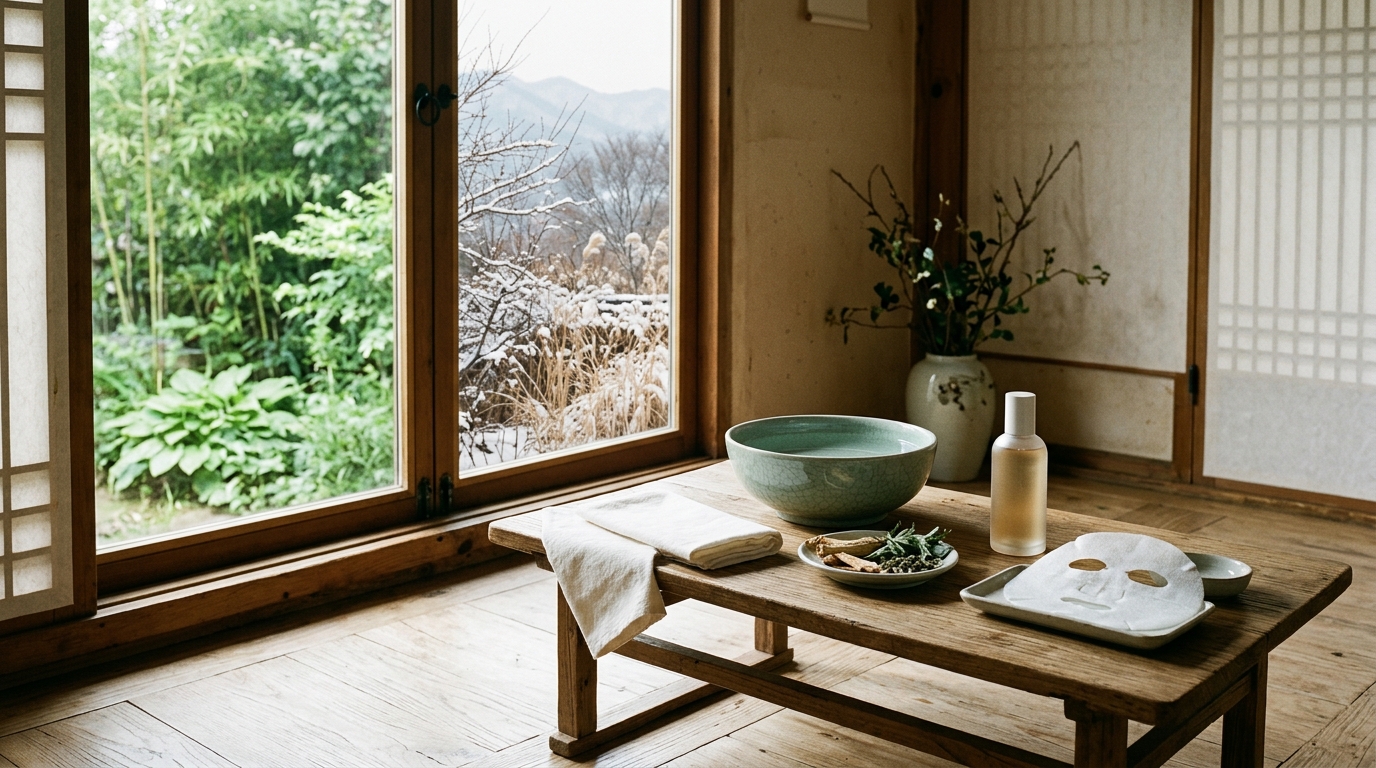
Korean skincare hydration is often presented as a modern beauty trend, yet its deeper logic is easier to understand when history, climate, aesthetics, and skin biology are considered together. The Korean tradition did not use today’s vocabulary of humectants, ceramides, transepidermal water loss, or sheet-mask serum. It did, however, place lasting value on cleanliness, a calm and well-tended complexion, restrained color cosmetics, and regular care using materials available in the household and season.
That distinction matters. It would be inaccurate to claim that a contemporary multilayer routine has remained unchanged for centuries. A more defensible interpretation is that modern Korean beauty translated older preferences—clear-looking skin, subtle presentation, daily maintenance, and adaptation to the seasons—into water-rich formulas, essences, emulsions, sleeping packs, and hydrating sheet masks. In this sense, hydration is not merely an ingredient claim. It is the practical foundation for a desired skin condition: comfortable, flexible, luminous, and less visibly rough.
Hydration as a condition of skin, not a temporary glossy effect
In everyday beauty language, “hydrated” is sometimes confused with “shiny.” They are not the same. Shine may come from sebum, makeup, lighting, or an oily surface. Hydration refers mainly to water held in the outermost layers of the skin. When that water is adequately retained, the surface usually looks smoother because tiny ridges and flakes are less pronounced. It can also feel more pliable and comfortable. Korean skincare hydration therefore makes sense as a base condition that supports the appearance of freshness rather than as a decorative finish applied at the end.
This helps explain why the ideal often associated with Korean beauty is described through words such as clear, moist, supple, translucent-looking, or dewy. The official Korea.net overview of Korean cosmetics linked the modern aesthetic to a clean and clear complexion and to dewy, youthful-looking skin. Those phrases describe an appearance, but the routine behind them is usually preventive and cumulative: cleanse without unnecessary stripping, restore water, reduce evaporation, and repeat consistently.
The philosophy is less about forcing a dramatic overnight transformation and more about maintaining a favorable environment at the skin surface. A single application can temporarily improve feel and appearance, but the cultural appeal of hydration comes from repetition. Toner, essence, emulsion, cream, and masks are not scientifically mandatory as a fixed number of steps. Their shared logic is sequential comfort: add water-binding materials, soften the surface, then use a more protective layer when the climate or skin condition calls for it.
Historical roots: cleanliness, restraint, and the cultivated natural complexion
The historical record does not support a simple slogan such as “Koreans have always followed a ten-step routine.” What it does show is a long-standing relationship between grooming, cleanliness, skin care, and social ideals. The Academy of Korean Studies’ encyclopedia entry on cosmetics describes a Korean preference for subtle makeup and an emphasis on bringing out inherent beauty rather than radically remaking the face. It also records the importance of clean-looking skin and the use of washing, oils, powders, facial preparations, and household beauty materials across different periods.
Late-Joseon research adds another useful detail. A study in the Journal of Japanese Culture reports that families made homemade cosmetic waters and creams from locally and seasonally available materials, including grains, vegetables, herbs, and fruits. These preparations should not be romanticized as automatically safe or scientifically equivalent to modern cosmetics. Their historical significance lies elsewhere: skin care was connected to domestic knowledge, seasonality, and routine preparation rather than only to color makeup.
Confucian-era restraint also influenced the visual language of beauty. Heavy, conspicuous makeup could carry different social meanings from light grooming. A well-kept face with restrained color therefore communicated composure, propriety, and care. Hydration fits this aesthetic because a smooth, comfortable surface allows the face to appear tended without requiring dense coverage. Modern “no-makeup makeup” is not identical to Joseon practice, but both can be understood within a broader preference for an appearance that seems cultivated rather than obviously constructed.
| Historical or cultural thread | What it emphasized | Modern hydration expression | Important limitation |
|---|---|---|---|
| Cleanliness and regular grooming | A cared-for, orderly appearance | Gentle cleansing followed by moisture replacement | Modern formulas and hygiene standards are different from historical preparations |
| Restrained color cosmetics | Enhancing rather than visibly transforming the face | Skin texture and luminosity become central to the finished look | Beauty ideals varied by class, era, occupation, and individual |
| Household and seasonal materials | Practical adaptation to what was locally available | Seasonal changes in texture, layering, and occlusion | Natural ingredients can still irritate or cause allergy |
| Daily maintenance | Consistency and personal discipline | Repeated light layers instead of occasional aggressive treatment | More steps do not automatically produce better results |
Korea’s seasons made adaptability part of the beauty logic
Environmental conditions help explain why a flexible hydration culture became useful. Korea has four distinct seasons; the Korea Tourism Organization summarizes the pattern by noting that summer is hot and humid, and winter is cold and arid. Indoor life adds another layer. Air conditioning can make summer interiors feel dry, while heated winter rooms can accelerate surface water loss even when the outdoor air is already cold and dry.
A single heavy cream is not equally comfortable in every season. A humid summer may favor lighter water-based layers and careful cleansing of sweat and sunscreen, while winter may call for richer emollient and occlusive support. Spring winds, fine dust, rapid temperature changes, and fall dryness can also alter comfort. The enduring principle is not “use the same many steps every day,” but “observe the skin and adjust the balance between water, oil, and protection.”
This adaptive habit is one reason Korean routines often distinguish texture so carefully: watery toner, viscous essence, lotion-like emulsion, gel, cream, balm, and sleeping pack. These categories overlap, and marketing names are not scientific guarantees. Still, the range gives users a language for modulation. Someone may use only a gentle low-pH cleanser and a barrier-supporting moisturizer on a calm day, then add a hydrating layer or a hydrating sheet mask when tightness, travel, wind, or indoor heating increases discomfort.
Climate also helps explain why indoor humidity matters. A small hygrometer can reveal whether a heated room is unusually dry, while a properly maintained humidifier may improve room comfort. Neither device hydrates skin by itself, and excessive humidity can encourage mold or dust mites. The practical lesson is environmental moderation, not maximal moisture.
The skin science behind water retention and barrier support
The outermost epidermal layer, the stratum corneum, is often compared with a brick wall. Flattened corneocytes function like bricks, while lipids around them act like mortar. This structure slows the movement of water out of the body and limits entry of irritants. Imaging research describes how the stratum corneum retains hydration through its structure and chemical composition; when that organization is compromised, dry, rough, or easily irritated skin can follow.
Hydration products work through several complementary mechanisms. Humectants attract or bind water in the upper skin. Emollients fill spaces between rough surface cells and improve flexibility. Occlusives form a partial film that reduces evaporation. Dermatology literature commonly describes moisturizers through these three functional groups: humectants, emollients, and occlusives. Many formulas combine all three because water addition without retention may feel brief, while a purely occlusive layer can feel heavy if the skin beneath it lacks water-binding support.
- Humectant role: ingredients such as glycerin, hyaluronic acid, urea, and certain sugars help hold water near the skin surface.
- Emollient role: fatty alcohols, esters, oils, and lipid blends smooth the spaces between dry surface cells.
- Occlusive role: petrolatum, waxes, silicones, and richer butters reduce the rate at which water escapes.
- Barrier-lipid role: ceramides, cholesterol, and fatty acids may support the lipid organization needed for an effective barrier.
This biology clarifies why “layering” can be useful without making every layer essential. A watery product may deliver humectants; an emulsion may add emolliency; a cream may reduce evaporation. The sequence is practical because thinner products spread easily before thicker ones. Yet a well-formulated moisturizer can perform several functions alone. Korean skincare hydration is best understood as a modular system rather than a compulsory staircase.
It also explains why hydration and barrier care are closely linked but not identical. Water content can rise temporarily while the barrier remains irritated. Conversely, a barrier-supporting product may reduce water loss over time even if it does not create an immediate glossy look. The most meaningful signs are comfort, reduced flaking, less tightness after washing, and stable tolerance—not the number of visible layers on the face.
How sheet masks became a modern symbol of the hydration ritual
Hydrating sheet masks are modern cosmetic delivery formats, not unchanged relics from an ancient court. Their cultural power comes from how neatly they express older themes: a pause in the day, a water-rich preparation, close attention to the face, and visible self-care without heavy color cosmetics. Korea.net documented the international growth of Korean sheet masks in the 2010s and described moisturizing as one of their central functions.
A sheet temporarily holds serum against the skin and slows immediate evaporation. This short period of occlusion can increase the sensation of softness and may raise surface hydration for a time. The result is often especially noticeable when the skin is mildly dry. However, a mask does not permanently “force” large molecules deep into the skin, erase pores, detoxify the body, or replace medical treatment. Its most defensible role is temporary hydration, soothing, and ritualized rest.
The ritual matters psychologically as well. A premeasured mask asks the user to stop, sit down, and wait. That built-in pause converts skin care from a rushed task into a small ceremony. In Korean popular culture, masks also became social objects—used during travel, shared among family members, given as modest gifts, or worn while watching television. Hydration therefore became associated with accessibility and repetition rather than rare salon treatment.
Duration is important. Leaving a sheet on far beyond the labeled time does not guarantee more hydration. As the sheet dries, comfort can decline, and prolonged contact with fragrance, preservatives, or botanical extracts may increase irritation in susceptible skin. Follow the manufacturer’s directions, remove the mask while it remains moist, and seal in the remaining serum with a simple moisturizer when needed.
A practical hydration checklist built around observation, not excess
The most useful way to apply the Korean hydration philosophy is to simplify it into decisions. The goal is not to collect the largest routine. It is to protect comfort and barrier function while responding to climate, cleansing, and individual sensitivity.
- ☐ Notice how the skin feels ten minutes after cleansing. Persistent tightness may suggest that cleansing is too harsh or moisture replacement is insufficient.
- ☐ Use gentle cleansing and lukewarm water rather than scrubbing for a squeaky finish.
- ☐ Apply a hydrating layer to slightly damp skin, then use a barrier-supporting moisturizer before the surface fully dries.
- ☐ Choose lighter textures in hot, humid weather and more protective textures in cold, dry conditions.
- ☐ Treat a hydrating sheet mask as an optional short treatment, not a daily obligation or a cure.
- ☐ Read the ingredient list, especially when fragrance, essential oils, or known allergens have caused trouble before.
- ☐ Keep opened products clean, close lids promptly, and discard anything with an unusual smell, color, or texture.
- ☐ Track indoor humidity rather than guessing, and clean any humidifier according to its instructions.
- ☐ Introduce one new product at a time so that irritation has an identifiable cause.
Optional tools can support hygiene or convenience, but they should remain secondary to a sound routine. Examples include a soft face towel, reusable headband, clean applicator, skincare organizer, mask storage container, travel bottles, cooling tool, or cosmetic ingredient label magnifier. A silicone mask cover may reduce evaporation during a sheet-mask session, but it also increases occlusion and should be kept clean. A facial steamer can feel pleasant, yet excessive heat may worsen redness or sensitivity. A skincare mini refrigerator is unnecessary for most formulas unless the label specifies cool storage.
For a minimal routine, a gentle low-pH cleanser, fragrance-free moisturizer, and sunscreen may be enough. Additional options such as a hyaluronic acid serum, ceramide cream, soothing gel mask, or microfiber cleansing pads should solve a specific comfort or routine problem rather than merely add steps. The phrase “more hydration” should never become an excuse to ignore burning, swelling, acne flares, or persistent dermatitis.
Frequently asked questions about Korean skincare hydration
Why does Korean skincare use several light layers?
Light layers make it easier to adjust texture and comfort. A watery step can provide humectants, while a lotion or cream can smooth the surface and reduce evaporation. The approach is modular; it does not mean every person needs toner, essence, serum, emulsion, and cream at the same time.
Is “glass skin” the same as healthy skin?
No. Glass skin is a visual ideal influenced by hydration, exfoliation, sebum, makeup, lighting, and photography. Healthy skin can have pores, texture, freckles, scars, and occasional blemishes. Comfort and stable barrier function are more meaningful than mirror-like reflectivity.
Do sheet masks hydrate better than moisturizer?
They work differently. A wet sheet creates temporary occlusion and can produce a noticeable short-term increase in softness. A moisturizer is usually more practical for routine water retention and barrier support. A mask can supplement a routine but does not automatically outperform a well-formulated moisturizer.
Can oily skin be dehydrated?
Yes. Oil describes sebum; dehydration describes insufficient water in the upper skin. Harsh cleansing, over-exfoliation, dry air, and irritating acne products can leave oily skin tight and flaky. Lightweight hydration and a non-irritating moisturizer may be useful without trying to eliminate all oil.
Are traditional Korean ingredients inherently gentler?
No. Historical use can provide cultural context, but it does not guarantee purity, effectiveness, or safety for every person. Plant extracts contain many compounds, and some can irritate or sensitize skin. Modern preservation, concentration, formulation, and testing matter as much as the ingredient’s origin story.
How often should a hydrating mask be used?
There is no universal schedule. Occasional use may be enough for mild dryness or a relaxing ritual. Frequent use is unnecessary if the skin is comfortable, and it may be counterproductive when the formula contains fragrance or other irritants. Follow label directions and reduce use if redness, itching, or breakouts appear.
Conclusion: hydration as continuity, adaptation, and care
The importance of hydration in Korean beauty is best explained as a convergence rather than a single ancient rule. Historically, Korean grooming traditions valued cleanliness, subtle enhancement, household knowledge, and a composed natural appearance. Environmentally, sharply changing seasons rewarded flexible textures and repeated adjustment. Aesthetically, smooth and luminous skin made restraint in color cosmetics more convincing. Scientifically, the water content and lipid organization of the stratum corneum affect softness, flexibility, and barrier performance.
Modern Korean skincare turned those compatible ideas into a recognizable language of toners, essences, emulsions, creams, sleeping packs, and sheet masks. Some of that language is cultural; some is technological; some is marketing. The useful core remains simple: cleanse gently, replace water, reduce unnecessary water loss, respect individual sensitivity, and adapt to the season. Korean skincare hydration is therefore less a fixed number of steps than a philosophy of attentive maintenance—small, repeatable acts that aim to keep the skin comfortable enough to look like itself.