Sleep can feel mysterious because the same bedtime sometimes produces a good night and sometimes does not. One of the missing variables is often light. The light exposure sleep connection is not simply about whether a room feels bright; it is about when light reaches the eyes, how intense it is, how long it lasts, and what wavelengths are present. Those signals help the brain decide whether it is biological daytime or biological night.
This matters because the human sleep-wake system is not a simple on-off switch. Sleep pressure builds the longer you are awake, while the circadian system supplies a roughly 24-hour timing signal that helps determine when alertness rises and when sleepiness becomes easier. Light is the strongest environmental cue for aligning that internal timing with the outside day. In practical terms, a bright morning and a darker evening usually send a clearer day-night message than a dim indoor day followed by a brightly lit night.
The useful takeaway is not that every person needs the same number of minutes in the sun or the same lamp setting. Research shows meaningful differences in individual sensitivity to evening light, so rigid universal thresholds can be misleading. A better approach is to shape the pattern of the day: establish a reliable morning light routine, seek adequate daytime light, reduce unnecessary brightness near bedtime, and keep the sleep period genuinely dark when possible.
Why light can change sleep without you noticing
The eye does more than create vision. Specialized retinal pathways send information about environmental light to the suprachiasmatic nucleus, or SCN, a small region in the brain that functions as a master circadian clock. In other words, the brain’s master clock responds to light reaching the eyes, and that timing signal helps coordinate sleep, hormone release, body temperature, and other daily rhythms. The National Institute of General Medical Sciences explains that the SCN helps regulate melatonin according to the amount of light the eyes receive.
Melatonin is often called a sleep hormone, but it is more accurate to think of it as a biological-night signal. In a normally aligned schedule, melatonin tends to rise in the evening as the environment becomes darker. Strong or biologically potent light late in the day can suppress or delay that signal in some people. That does not mean light is the only cause of insomnia; stress, pain, sleep apnea, medications, restless legs, mood disorders, irregular schedules, caffeine, alcohol, and many other factors can also disturb sleep. Light is simply one controllable input with unusually strong effects on circadian timing.
The timing of exposure is crucial. The same bright light that can be useful after waking may be counterproductive near a desired bedtime. CDC/NIOSH guidance notes that the circadian system is especially sensitive to light around the late evening, overnight, and near the usual wake period, with morning and evening exposure tending to shift timing in opposite directions.
| Part of the day | Typical circadian message | Possible sleep implication | Practical environment goal |
|---|---|---|---|
| After waking | Day has started | Can reinforce earlier circadian timing and alertness | Use daylight or a bright daytime environment |
| Middle of day | Continue biological daytime | Supports a strong day-night contrast | Avoid spending the entire day in very dim rooms |
| Late evening | Should gradually transition toward night | Excess light can delay sleepiness in sensitive people | Reduce brightness and use dim, warm-toned lighting |
| Sleep period | Biological night | Light can interfere with darkness signaling or awakenings | Keep the room as dark as practical |
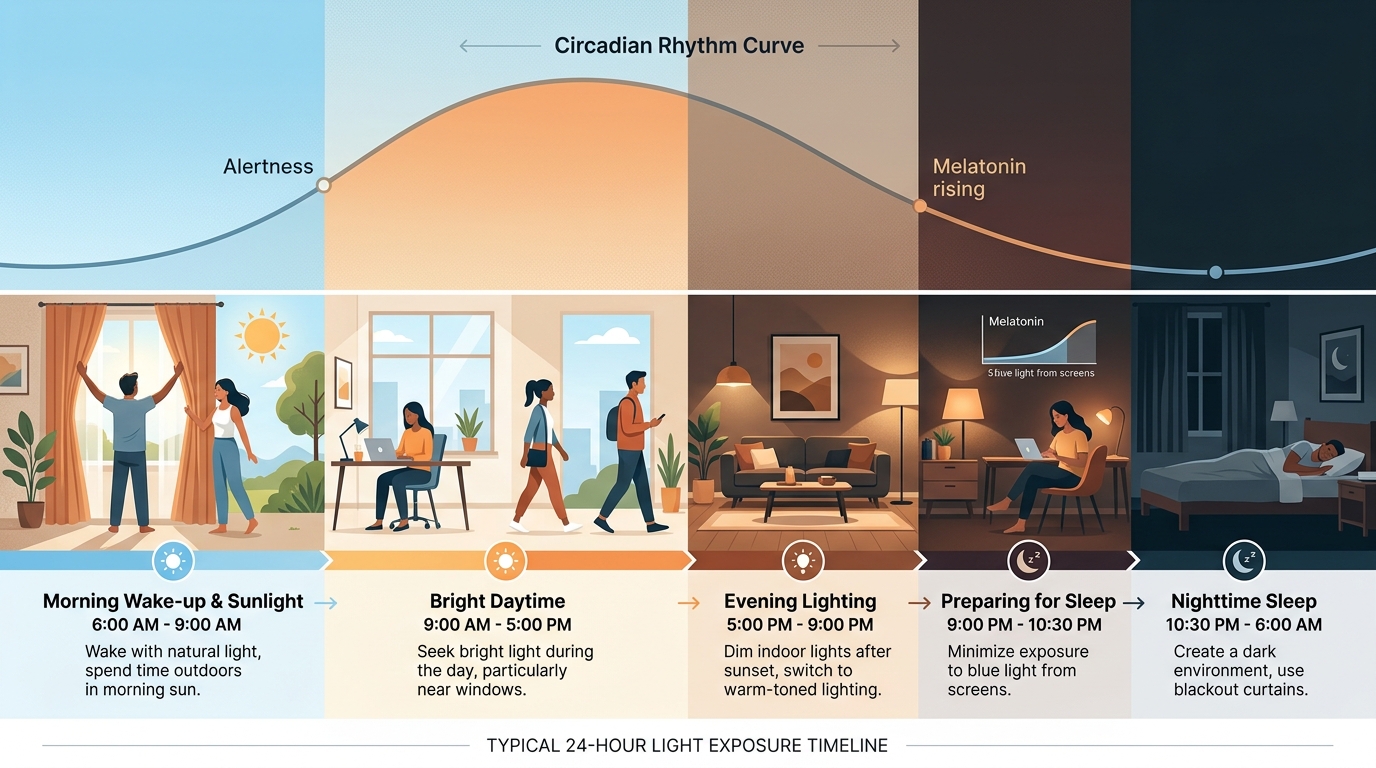
Morning light is a timing cue, not a magic sleep treatment
Morning light is useful because it arrives when the circadian system is capable of interpreting it as the start of the day. For a person who sleeps at conventional nighttime hours, bright light soon after waking generally supports an earlier phase, meaning the body may become ready for sleep earlier that evening. CDC/NIOSH summarizes this pattern by explaining that morning light can move circadian timing earlier, while evening light can move it later.
This does not justify a universal prescription such as “exactly 10 minutes at sunrise.” Season, latitude, cloud cover, window exposure, work schedule, chronotype, age, eye health, and individual sensitivity all affect the dose that actually reaches the retina. Outdoor daylight is typically much brighter than ordinary indoor illumination, but the goal for a general reader is better framed as consistency rather than chasing an exact lux target. A repeatable morning light routine is easier to sustain and less likely to become another sleep rule that causes anxiety.
There is also an important distinction between ordinary daylight exposure and formal bright-light therapy. The former is an everyday environmental habit; the latter may use controlled intensity and timing to treat specific circadian or mood conditions. If someone is trying to shift a severely delayed sleep schedule by several hours, works rotating night shifts, or has a diagnosed circadian rhythm disorder, timing becomes more complex than the general “bright morning, dim evening” rule.
- Open blinds or curtains soon after waking when outdoor conditions allow.
- Spend part of the morning near daylight rather than remaining in a dark bedroom.
- If possible, step outdoors during the early part of the day while still using appropriate sun protection.
- Keep wake time reasonably stable so the light signal arrives at a similar biological time.
- Do not assume that brighter is always better; duration, timing, spectrum, and prior light history all matter.
Daytime brightness helps create contrast between day and night
Many modern routines flatten the natural light-dark cycle. A person may spend the day in a relatively dim office, commute after sunset, then sit under bright ceiling fixtures and multiple screens until bedtime. The result can be a weak contrast between “day” and “night.” From a circadian perspective, that contrast matters because the internal clock adapts to patterns, not isolated moments.
Research also suggests that prior light exposure can influence how strongly the circadian system responds to later light. Experiments have found that the effect of evening light is not determined by a single brightness reading alone; the history of daytime and early-evening exposure can change sensitivity. That helps explain why two people can sit in the same room at night and experience different biological effects, and why one person’s own response may vary across days.
A useful practical principle is to make daytime look like daytime. That may mean taking a walk outside, choosing a workspace with more daylight, or periodically leaving a dim interior. These steps are not guaranteed insomnia treatments, but they improve the environmental signal the circadian system receives. They also reduce the temptation to treat sleep as a problem that begins only at bedtime.
For people who track their environment, a simple light meter can illustrate how dramatically illumination changes between a room, a window, a shaded outdoor area, and open daylight. The number should be treated as context rather than a medical target. Consumer sensors are not the same as laboratory measurements of melanopic light at eye level, and a phone-based reading may be especially approximate.
Evening light can extend biological twilight
Electric lighting makes it possible to keep the visual environment bright long after sunset. That is convenient, but it can blur the biological boundary between day and night. A field study of real homes found large differences in evening melanopic illuminance and large differences in individual circadian light sensitivity. In that study, greater evening light relative to a person’s own average was associated with more wakefulness soon after bedtime. The broader lesson is that evening home lighting can influence melatonin and early-night sleep, but the magnitude varies widely from person to person.
That variability is why simplistic rules such as “all LED light is bad” or “blue light is the only problem” miss the point. Spectrum matters because melanopsin-containing retinal pathways are especially responsive to shorter wavelengths, but intensity, duration, distance, direction, and timing also matter. A very bright warm-looking room can still deliver a substantial circadian signal, while a dimmer screen farther from the face may deliver less than expected.
Instead of obsessing over one color, think in layers. First reduce total light level as bedtime approaches. Second, use lower-positioned and less glaring sources when practical. Third, favor dim, warm-toned lighting for routine evening tasks. Fourth, avoid turning on bright overhead lighting during a brief nighttime awakening unless safety requires it. If scheduled lighting is already part of a smart-home setup, gradual dimming can make the transition more automatic without turning sleep into a complicated ritual.
For readers who need darkness but live with streetlights, hallway light, or an early-rising partner, blackout curtains, a blackout roller shade, a blackout curtain liner, or a comfortable sleep mask can be environmental tools rather than “sleep cures.” Their purpose is simply to reduce unwanted light during the intended sleep period. The right choice depends on the source of the light and whether ventilation, emergency visibility, or household safety could be affected.
Screens matter, but the room around the screen matters too
Phones, tablets, televisions, and computers receive attention because they combine light with stimulating content. The light component can affect circadian timing, but the behavioral component matters as well. A person who keeps scrolling, gaming, working, or watching emotionally engaging material may delay bedtime even if the display is dim. Therefore, screen advice works best when it addresses both biology and behavior.
Night modes and warmer display settings may reduce short-wavelength output, but they do not make a bright screen biologically invisible. Brightness, viewing distance, exposure duration, and the surrounding room remain relevant. If the rest of the room is dark, a screen can also become the dominant light source at the eyes. Conversely, simply switching off a device while leaving bright ceiling lights on may not create the low-light environment the circadian system expects before sleep.
A practical sequence is more useful than a perfection rule: finish visually demanding tasks earlier when possible, lower display brightness, shift to warmer settings, dim the room, and create a stopping cue for stimulating content. If reading before bed is relaxing, a clip-on reading light or bedside lamp can provide localized illumination without lighting the entire room. Again, the point is not to recommend a specific product; it is to preserve enough light for comfort and safety while avoiding unnecessary whole-room brightness.
Darkness during sleep protects the night signal
Once the intended sleep period begins, the environmental goal changes from “reduce evening light” to “maintain darkness.” Light entering the bedroom from windows, doors, charging indicators, televisions, clocks, or adjoining rooms can raise the background level. Whether that is enough to disturb sleep depends on brightness, eye exposure, sleep stage, and individual sensitivity, but eliminating avoidable light is a low-complexity part of sleep hygiene.
Start with the obvious sources. Turn off decorative or indicator lighting that is not needed, cover or redirect bright device LEDs when safe to do so, and close curtains or shades. A room does not have to be laboratory-dark to be sleep-friendly. The practical aim is to avoid light bright enough to wake you, keep you alert, or create a strong biological daytime signal during the night.
If you wake briefly, use only enough light to move safely. A low, warm bedside lamp or motion-activated pathway light can be preferable to a bright ceiling fixture. People who need to use the bathroom at night should prioritize fall prevention over darkness; the safest solution is not always the dimmest possible one.
A practical 24-hour light routine
The most useful way to apply the science is to think across the full day. Light exposure sleep habits are easier to improve when morning, daytime, evening, and nighttime cues point in the same direction. The checklist below is intentionally flexible because individual schedules and sensitivities differ.
- After waking: expose yourself to a brighter environment and, when practical, daylight.
- Morning: keep the morning light routine reasonably consistent with your regular wake time.
- Daytime: avoid spending the entire day in unusually dim surroundings if you can access daylight.
- Late afternoon: continue normal activity; do not begin dimming the entire day too early unless your schedule requires it.
- Two hours before bed: begin reducing unnecessary room brightness, especially strong overhead glare.
- Last hour before bed: use dim, warm-toned lighting and lower screen brightness if screens are still necessary.
- At bedtime: close blinds, shades, or curtains and remove avoidable light sources.
- During nighttime awakenings: use the minimum safe light needed to move around.
- Across the week: use scheduled lighting only as a convenience for consistency, not as a substitute for regular sleep opportunity.
For someone who currently has a very bright evening environment, the first experiment can be simple: for one week, keep wake time fairly stable, get more light early in the day, and dim the home during the final two hours before bed. Keep other major sleep variables as stable as practical. Then note whether sleepiness arrives more naturally, whether bedtime drifts less, and whether awakenings feel different. This kind of self-observation is more informative than changing five sleep habits at once.
Why identical lighting does not produce identical sleep
One of the most important findings in modern circadian research is that people are not equally sensitive to evening light. A PNAS study found more than a 50-fold range in the light level associated with half-maximal melatonin suppression among healthy participants. That means a household lighting level that barely affects one person could have a much stronger biological effect on another. Individual sensitivity to evening light varies substantially, so personal response matters when interpreting general advice.
Age, chronotype, prior light exposure, pupil size, genetics, medications, and health conditions may all contribute to variability. This also explains why one partner may fall asleep easily with a television on while another finds the same environment disruptive. The right goal is not to prove who is “more sensitive,” but to design a shared environment that protects sleep without creating conflict.
If one person reads later, a localized amber bedside lamp or clip-on reading light can reduce spill into the whole room. If one person rises earlier, blackout curtains or a sleep mask may help the later sleeper. If household routines vary by day, a smart bulb timer or smart plug controlling a lamp can automate dimming. These examples are environmental strategies, not endorsements of particular brands or claims that devices will treat insomnia.
Frequently asked questions about light exposure and sleep
1. Is morning sunlight required, or does indoor light count?
Indoor light still reaches the circadian system, but outdoor daylight is often much brighter. If outdoor exposure is practical and safe, it can provide a stronger daytime signal. When it is not practical, sitting near daylight and using a brighter daytime environment may still be more useful than remaining in a dim room.
2. How long should I get morning light?
There is no single duration that fits every person and every season. Light intensity, cloud cover, latitude, time of year, eye exposure, and sensitivity all change the effective dose. Consistent exposure after waking is a more defensible general principle than promising that one exact number of minutes will work for everyone.
3. Are blue-light-blocking glasses necessary for good sleep?
Not necessarily. Reducing total evening brightness, shortening exposure, increasing distance from bright sources, and using warmer settings can all matter. Glasses may be useful in specific situations, but they are not a substitute for a darker evening environment and a regular sleep schedule.
4. Is a warm-colored bulb always safe at night?
No light source is automatically circadian-neutral simply because it looks warm. A bright warm source can still deliver enough light to matter, especially at close range or for a light-sensitive person. Think about intensity and duration as well as color.
5. Should I sleep in complete darkness?
Darkness is the clearest night signal, so reducing unnecessary bedroom light is reasonable. However, safety comes first. Older adults, people at risk of falls, and anyone who needs to navigate the room at night may be safer with a very low pathway light rather than total darkness.
6. Can changing light exposure cure insomnia?
No. Light timing can improve circadian alignment and may remove one source of sleep disruption, but insomnia can have many causes. Persistent sleep difficulty deserves broader assessment, especially when it affects daytime function or continues despite adequate sleep opportunity and basic sleep-hygiene changes.
Conclusion: shape the contrast, not just the bedtime
The strongest insight from circadian science is that sleep begins long before you get into bed. Your brain has been reading the light environment since morning, comparing bright and dim periods and using those signals to estimate the time of day. When the pattern is bright enough during biological daytime and progressively darker toward biological night, the internal clock receives a clearer message.
For most people, the practical strategy is straightforward: build a consistent morning light routine, seek meaningful daytime light, reduce unnecessary evening brightness, use dim, warm-toned lighting as bedtime approaches, and keep the sleep period dark. Tools such as scheduled lighting, blackout curtains, a blackout roller shade, a blackout curtain liner, a sleep mask, a smart bulb timer, or a simple light meter can support those environmental goals, but they are secondary to the pattern itself.
The light exposure sleep relationship is therefore best understood as a 24-hour system rather than a single “blue light before bed” rule. Morning light can anchor the day, evening dimness can protect the transition toward night, and darkness can preserve the sleep period. Because individual sensitivity differs so widely, the most useful routine is one that follows these biological principles while remaining realistic enough to repeat every day.